
a note on alignment
You know the feeling you get when things feel out of alignment? Personally, it can feel like a cocktail mixed with light chaos, a tiny bit of confusion, unmet needs, and often times a dash of bitters.
I started this studio with the idea that I'd never feel out of alignment again. It was an agreement that I made to myself. That agreement comes in many forms to make sure I'm doing the best work that I can possibly be doing. One part of that agreement is something that I aim to honor with every client I work with.
I call it brand strategy.
Every so often, a founder comes to me wanting just a logo.
This is typically the moment where a big pause is needed for both myself, and the person on the other side looking to elevate their business.
They don't usually need just a logo.
What they actually need is a mirror.
A mirror that reflects the questions their audience is (and will be) asking.
Who is this really for?
Why should I trust this?
Why this... and why now?
If those answers aren’t clear, no logo, website, or beautifully designed packaging is going to magically solve it.
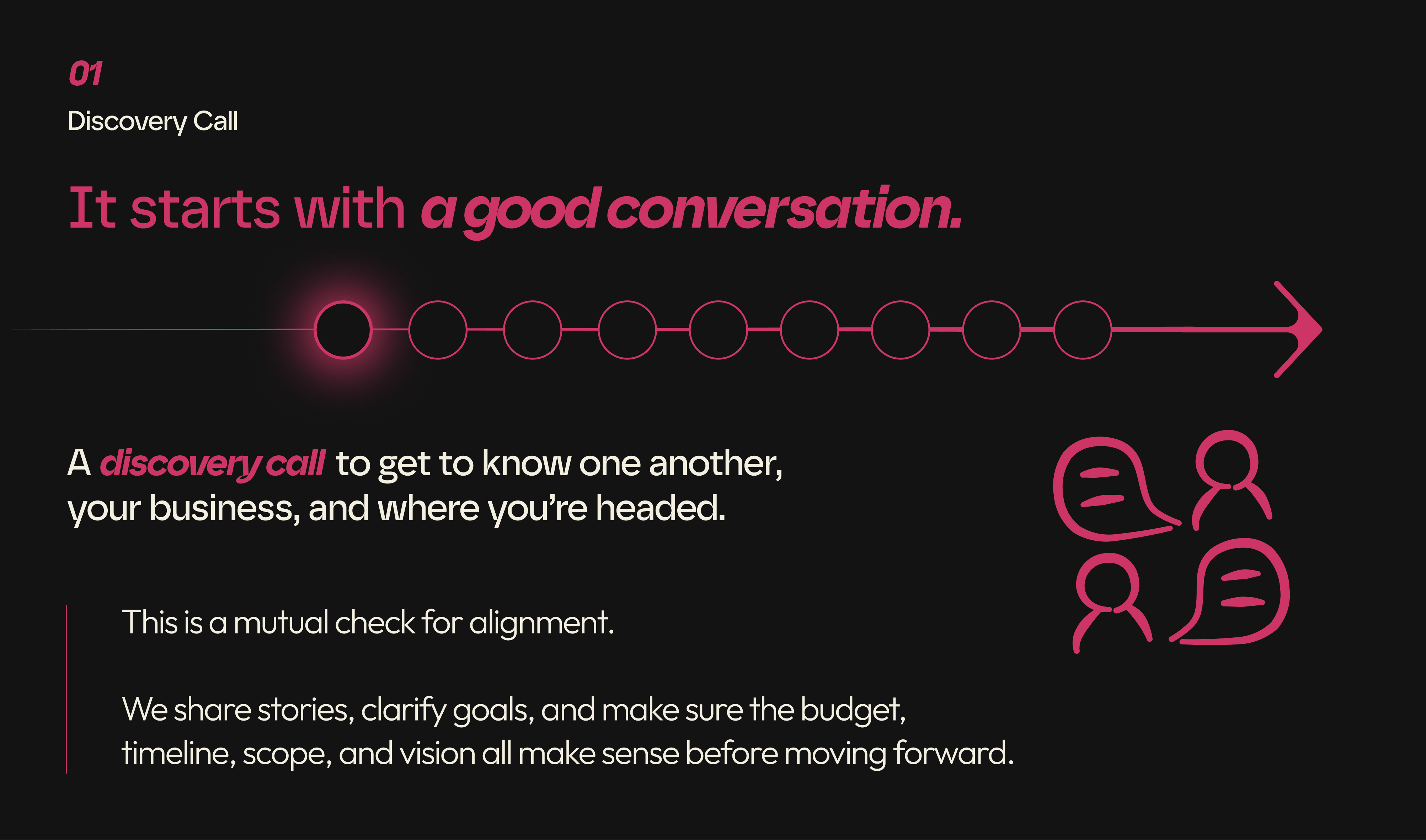
That’s why every project I take on starts with an in depth strategy workshop.
Before visuals, before layouts, before anything gets “designed,” I come with 20-25 completely unique, out of the box (sometimes seemingly bizarre) questions to help us get into alignment with where your business is headed.
In about an hour, together, we walk through all sorts of different scenarios.
It's conversational, fun, and deeply educational for us both.
I might be asking you something like...
"If your brand were a person and you invited them over to a friend's dinner party to meet everyone for the first time, how would you introduce them?"
"If your presence were a painting, would it be bold and geometric, soft and fluid, precise and minimal, or something else entirely?"
"If your brand opened like the first scene of a film, what would we see, hear, and feel in the first ten seconds?"
"If your brand were a building people could walk into five years from now, what would it look, feel, and sound like, and how would it have evolved from today?"
Questions like these always spark a deeper conversation, and we end up uncovering more than most expect to share in about an hour.
It's an excellent place for us to start, and this is by far my favorite part of the process, because I really get to see your wheels start turning.
listening.
I've always considered myself an excellent listener, and during these strategy workshops, I get to take in everything that is both said and left unsaid.
The pauses between your words, the parts that you smile about and the others where you're eager to grow, and the moments where you begin imagining what's next.
What comes out of these sessions is more than alignment. It’s a foundation. A shared understanding of what you think, what you say, and what you do.
As Mahatma Gandhi put it, “Integrity is the alignment of what you think, what you say, and what you do.”
That alignment is what everything else gets built on.
And honestly?
It's my favorite part of the process.


from designing buildings to businesses
The process is more similar than you’d think.
I spent many years as a practicing architect. And one thing you learn quickly in that world: you never start with the façade. You don’t pick the style of windows first. You don’t choose materials because they look good on their own.
You start with the site.
The climate.
The wind, soil, what grows where.
The people who will actually inhabit the space.
The surrounding context and the neighbors that won't inhabit the space, but will definitely be affected by a new development.
You study how light moves through a room at different times of day. How someone feels the moment they walk through the front door. Where they pause. Where they move. Where they stay.
You zoom out to understand the full context.
Then you zoom all the way in to the smallest detail.
The way a handrail meets the wall. The waterproofing details at the sill of a sliding glass door. The sound of footsteps on the floor, or perhaps no sound at all.
That’s how I approach every brand and website I take on.
building your foundation.
Before I design anything visual, I need to understand the foundation.
What’s the terrain?
Who is this for?
What are your competitors like?
What does your audience need to feel when they encounter you?
What is your audience tired of?
The logo is just the paint.
The strategy is the foundation.
Skip the foundation, and the whole thing eventually cracks. You'll spend more money on fixing those cracks than if you had just spent a little energy upfront on getting into deep alignment.
I've spent my entire life learning how to design spaces that make people feel something before they understand why. That training never left me.
It just found a new medium.
Your brand.

on to the visual magic
sketching.
Once the foundation is set, this is where things start to come alive.
But before I open any design software, before I touch layouts or pixels, I slow things down again.
I sketch. And I sketch and sketch and sketch.
By hand. On paper. And usually outside.
I like to take things off screen because the internet has an annoying way of telling you what already exists. Nature doesn’t seem to be so restricting.
A pen and paper don’t either. There’s something about sunlight, fresh air, some matcha, and a few several blank pages that lets ideas come through with a bit more gusto.
I allow this part to be messy. Loose. Intuitive. It’s where shapes, symbols, logos, color, and energy start to surface without being judged too early.
I typically take concepts too far, intentionally, so that I can reel them in.
Sometimes when I subtract from the concepts that feel extra, magic can unfold and the design starts to reveal itself. This is one of the more special parts of design and art, and I'm always astonished when it occurs.
stylescapes.
From there, I move into visual studies and moodboarding. I spend some time building out logos, typography, color systems, and variations of everything until they start to feel good enough to dial in.
I choose two unique concepts and I build out what I call stylescapes.
Instead of one polished direction, I build two distinct visual worlds.
These are two fully formed interpretations rooted in the same strategy that we've been aligned on.
Each one shows how your brand could exist in the real world through photorealistic mockups that tell a unique story.
If there's a website, you’ll see it across different pages and moments.
If it’s food or hospitality, you might see menus, packaging, signage, or the space itself.
If it’s a personal brand, you’ll see how it shows up in writing, newsletters, social, or of course, your website itself.
If it’s a product, you’ll see it in context, being used, held, lived with by your audience type.
The goal isn’t to pick what looks nicest, either.
It’s to feel what’s most aligned.
Because when the strategy is strong as ever, and the visuals are born from that place, your brand doesn’t just look good.
It feels insatiable.
And that’s when everything starts flow.

refinement and momentum
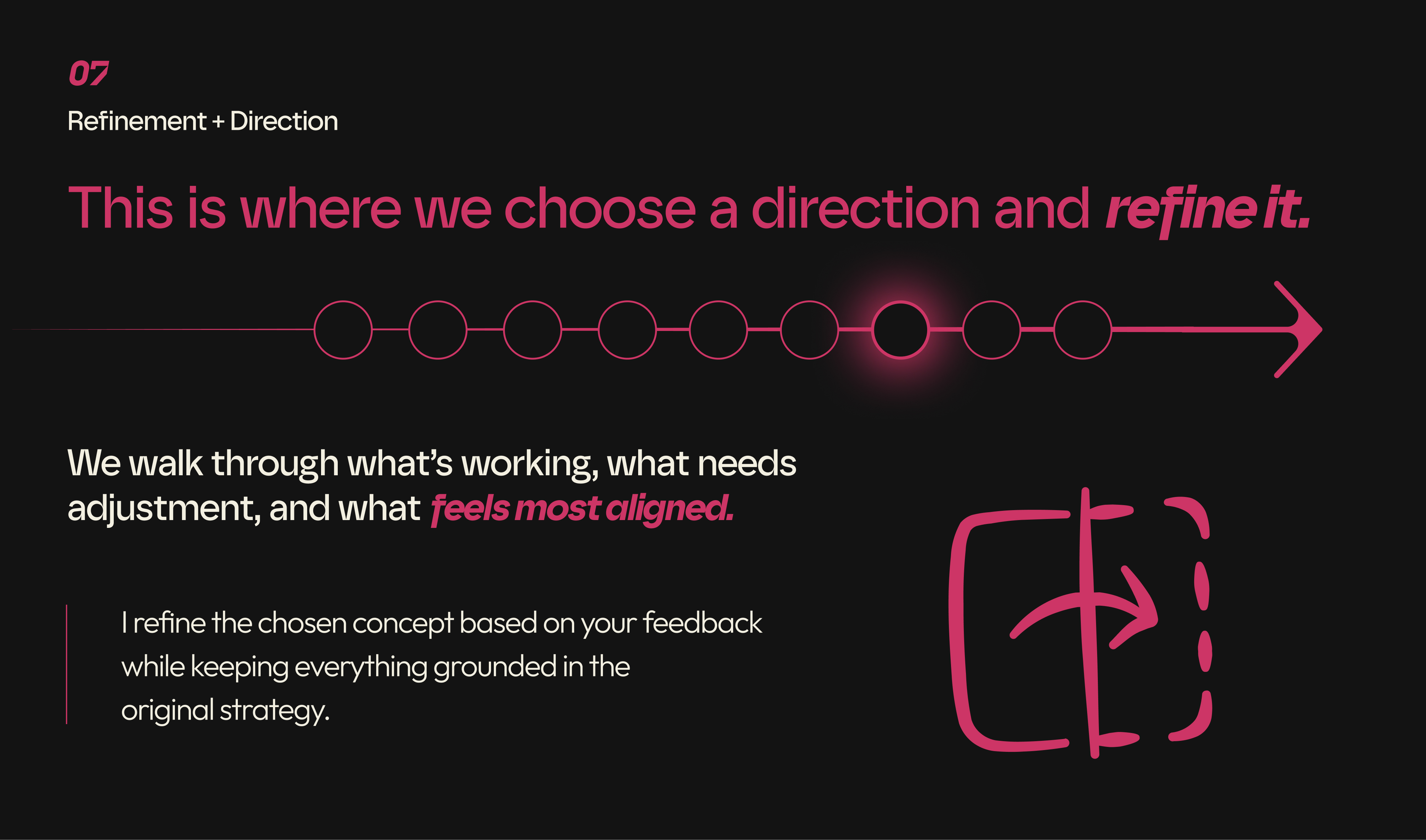
From the two concepts, we choose one direction and refine it together.
I typically include one focused revision round here, unless we’ve agreed otherwise.
And by the time we get here, we’re not guessing anymore.
We’ve spent time talking through what’s working and what isn’t.
And it's not from a place of taste either, but from alignment, and what we both believe your audience will truly trust and relate to.
Maybe the concept wants a slightly more optimistic color to better match the energy of your audience.
Maybe the hand-drawn logo is feeling a tad off, and it wants a touch more refinement to support where the brand is headed.
Maybe we realize your audience responds more to warmth than precision, or clarity over cleverness.
Or, in the case of a personal brand, you might want to explore a wordmark that feels quieter, more grounded, or more open.
This is where those decisions get made.
And I love this part. A stage in the design process that once terrified me, actually!
But I've found that once I started getting into more alignment with my client and their needs, and being completely honest with one another, that this part of the process could be rewarding, and a bit magical. I've learned to set the ego aside and to listen as humanly possible, so that together, we're able to create something lasting. Something we're all proud of.
I take everything from our last conversation and spend the time getting it just right.
Sometimes that means adjusting the visuals.
Sometimes it means rethinking how the story unfolds across different moments.
Either way, I mock it all up again and walk you through it live after about a week or two.
These second meetings are usually where things click.
Clients tend to feel a sense of relief here.
Like, yesss, this is it.
The brand starts to feel real, usable, and ready to grow.
brand guidelines.
Once the direction is locked and the system feels solid, I build out a comprehensive brand guidelines document.
This isn’t a dusty PDF that lives in a folder no one opens.
It’s a practical, intentional guide that shows you how to actually use your brand in the real world, and just as importantly, what to avoid.
We define how all of your logos live across different contexts.
How typography flexes without losing its voice.
How color is used with purpose, not randomly.
How imagery, tone, and spacing work together to tell a consistent story.
It becomes a shared language.
One that keeps your brand intact as it grows beyond just the two of us working together.
As new collaborators come in.
As marketing expands.
As the business evolves.
Alongside the guidelines, you’ll receive a clean, organized folder of digital brand assets.
Everything you need to confidently show up without second guessing yourself.
What this really gives you is freedom.
You don’t have to reinvent the wheel every time you post, print, pitch, or publish something new.
You have a clear framework to return to.
A north star that keeps things aligned.


putting it into action
designing your website.
Once the brand is set, the website takes shape.
This is where strategy meets reality. We translate everything we’ve defined into structure, flow, and experience. Not just how it looks, but how it moves someone through your story.
Designing a website is remarkably similar to designing a building.
How a person is guided through your space in the physical realm tends to be so damn similar to how they're guided in the digital realm. I've found incredible similarities, which makes designing your digital storefront all the more rewarding.
Having your copy ready here matters. It lets us focus on hierarchy, pacing, and clarity instead of guessing. I’m always happy to refine language, write taglines, and shape messaging using the strategy we built together. But when your voice is clear, the site comes together faster and stronger.
I design and build with the same lens:
What someone understands in the first five seconds.
Where trust is built.
Where action feels natural.
Whether I build it in Framer, Webflow, or we hire a developer, the goal is simple.
A site that feels grounded, intuitive, and true to your brand.
And when it’s ready, we review it together, we make any tweaks necessary, and then we publish it!
handoff.
Once everything is live, I hand the keys over to you.
You’ll receive your full set of brand assets, guidelines, and access to your site. I walk you through how things work so you feel confident owning what we’ve built together.
For the first seven days, I stay close. Light maintenance, small technical questions, gentle tweaks if something needs adjusting. This isn’t a redesign phase, and the boundaries are clear. But I don’t disappear either.
My goal is for you to feel supported, not dependent.
After that, you’re free to take it forward. And if you ever want help evolving it, refining it, or expanding it down the line, we can always talk.
Good work should give you momentum, not friction.
let's work together.
If you’re building something that matters and want a partner who cares about alignment as much as execution, I’d love to meet you.